Fact of the day · History
The first car: 1886
Karl Benz patented his three-wheeled Motorwagen on 29 January 1886. It had less than one horsepower and a top speed of about 16 km/h.
Also available in PL · DE · UA · RU
Curious how a car really works? Explore every part through clear diagrams, cutaways and simple, jargon-free explanations.

Fact of the day · History
Karl Benz patented his three-wheeled Motorwagen on 29 January 1886. It had less than one horsepower and a top speed of about 16 km/h.
See a car in cross-section — from engine to suspension
The full diagram is available for ICE, hybrid, and electric cars
See all parts in cutawayPick a section to explore the car's construction in detail
Engine types and how they are built: cylinders, pistons, valves, plus the fuel, cooling and lubrication systems.
Open sectionWhat moves hybrids and electric cars: motor types, the stator and rotor, and how a motor also recharges the battery.
Open sectionHow fuel travels from the tank to the injectors, and how the exhaust is cleaned and silenced on its way out: the pump, filter, catalytic converter, particulate filter, AdBlue and muffler.
Open sectionHow engines, batteries and motors stay at the right temperature: the radiator loop, thermostat, pumps and fans — and the chiller that cools an EV's battery.
Open sectionManual, automatic, dual-clutch gearboxes, CVT, and the EV reduction gear.
Open sectionThe 12V battery, alternator and starter, plus the high-voltage pack, inverter and everything behind plugging an EV in.
Open sectionAll bulb types, headlight diagrams and complete fuse information.
Open sectionThe car's brain and nerves: control units, data networks like CAN, fault codes, software updates and protection from hackers.
Open sectionSuspension parts: shock absorbers, springs, control arms and stabilizers.
Open sectionHow the wheel turns the road wheels: rack-and-pinion, power assist, tie rods and steering knuckle.
Open sectionDisc and drum brakes, hydraulics, ABS and supporting systems.
Open sectionTire types and tread, wheel rims, and how grip changes with road surface and weather.
Open sectionWhat a car is built on: the shell or frame, pillars, floor, doors and hood, the steels and aluminium they are made from, and how it is all joined and protected from rust.
Open sectionAirbags, belts and crumple zones, ABS and ESP, and the radar and cameras behind modern driver aids.
Open sectionDashboard, seats, controls and comfort features.
Open sectionHow the cabin gets cooled, heated and dried out: the refrigerant loop, the blower and vents, and why EVs increasingly use a heat pump.
Open sectionSearch the Glossary: hundreds of car parts named in all five languages of the site — handy at a garage or parts shop abroad.
Open the Glossary →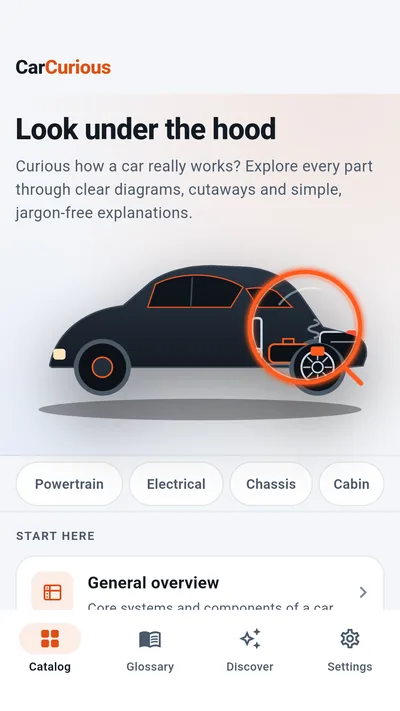
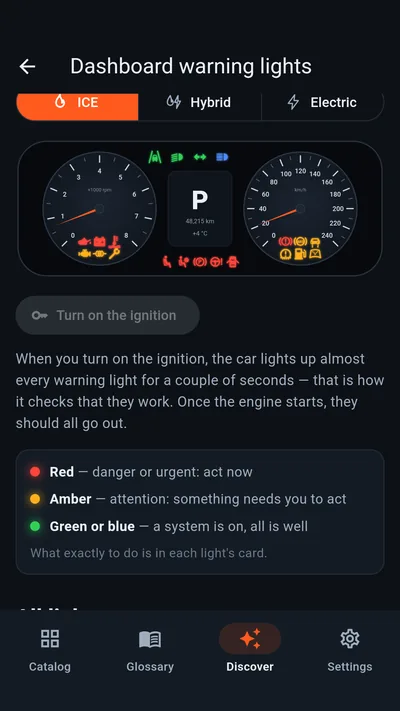
The same guide as an Android app — free, no ads, no account.
A free, illustrated guide to how cars work — no ads, no trackers, no sign-up. Written in plain language for people who are curious rather than trained.